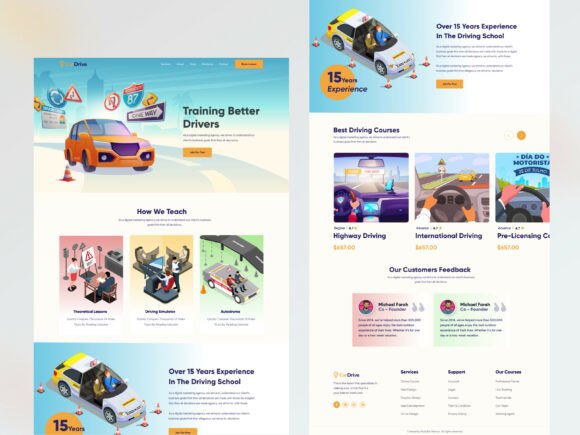
DrivePro – Modern Driving School Website: Redefining Digital Presence for Automotive Education
The landscape of automotive education has shifted dramatically in recent years. No longer is the primary interaction between a driving instructor and a potential student confined to a handshake at a local office or a phone call. The modern journey begins online, where first impressions are formed within milliseconds. In this digital-first environment, the quality of a website serves as a proxy for the quality of instruction provided. This is where DrivePro – Modern Driving School Website emerges as a critical resource. It is not merely a collection of design assets; it represents a strategic approach to building trust, clarity, and engagement for driving academies, independent instructors, and training platforms.
The Evolution of Trust in Online Learning Platforms
When individuals search for driving lessons, they are often navigating a high-stakes decision. For new drivers, passing a test is a rite of passage. For professional truck drivers seeking certification, it is a career pivot. In both scenarios, anxiety is a natural component of the process. A potential student looking for a school needs immediate reassurance that the institution is professional, safe, and competent. Generic templates or outdated designs fail to convey this level of reliability.
DrivePro – Modern Driving School Website addresses this psychological barrier through its core design philosophy. By utilizing bright illustrations and organized layouts, the UI kit creates an atmosphere of approachability without sacrificing professionalism. The visual language speaks directly to the user's need for safety and structure. When a visitor lands on a site built with these principles, they encounter a clear hierarchy of information that reduces cognitive load. Instead of wading through cluttered text, they see clear pathways to course descriptions, instructor profiles, and booking systems. This reduction in friction is essential for converting casual browsers into enrolled students.
Visual Storytelling in Automotive Training
One of the most distinct characteristics of the DrivePro design system is its reliance on creative illustration. In the context of a driving school, stock photography can sometimes feel generic or staged. Illustrations, when done correctly, offer a unique advantage: they can simplify complex concepts and inject personality into the brand. For example, explaining the nuances of defensive driving or the steps involved in a parallel parking maneuver can be visually represented in a way that is engaging and easy to digest.
This approach allows driving schools to differentiate themselves in a crowded market. A platform that uses standard photos of cars on highways blends into the background. However, a site that utilizes custom, bright, and engaging content blocks stands out. It signals that the academy invests in creativity and cares about the student experience from the very first click. This visual storytelling extends to testimonials and success stories, where illustrated avatars or stylized graphics can make social proof feel more authentic and less like a marketing afterthought.
Structuring Content for User Retention
Beyond aesthetics, the functional architecture of a driving school website determines its long-term viability. The organizational layout provided by tools like DrivePro – Modern Driving School Website ensures that critical information is accessible. A common failure point for educational websites is burying pricing or curriculum details deep within the site structure. Students and parents want transparency. They need to know exactly what is included in a package, how many hours of behind-the-wheel training are offered, and what the theoretical components entail.
Effective use cases for this structured approach include:
- Course Catalogs: Presenting different tiers of learning (e.g., beginner, advanced, defensive driving) in distinct, comparable cards that highlight features and benefits side-by-side.
- Instructor Profiles: Showcasing the expertise of the teaching staff with dedicated sections that highlight certifications, years of experience, and teaching philosophies.
- Learning Programs: Breaking down the curriculum into digestible modules, allowing users to understand the progression from classroom theory to road practice.
By organizing these elements logically, the website becomes a self-service tool that answers questions before they are asked. This autonomy empowers the user and builds confidence in the institution. Furthermore, a well-structured site supports better navigation across devices. With a significant portion of traffic coming from mobile devices—often students checking schedules or booking slots on the go—the responsive nature of the UI kit is paramount. The layouts adapt seamlessly, ensuring that the "Call to Action" buttons remain prominent and clickable regardless of screen size.
Implementing Modern Design Systems in Education
For business owners and educators who may not possess deep technical expertise, the implementation of a sophisticated website can seem daunting. Traditional web development often requires a steep learning curve or expensive agency fees. This is where the utility of a comprehensive Figma UI Kit becomes apparent. It bridges the gap between design intent and technical execution. By providing pre-designed components, the kit accelerates the development process while maintaining high design standards.
The workflow for integrating such a system typically involves several stages. First, the academy defines its brand identity and core value propositions. Next, designers utilize the modular blocks from the kit to assemble pages that reflect this identity. Because the components are already optimized for usability, the focus shifts from "how do I make this button work?" to "what message does this section convey?". This shift in focus allows educators to concentrate on their pedagogy while still delivering a world-class digital product.
Moreover, the flexibility of the design system allows for scalability. As a driving school grows, adding new courses or expanding to new locations should not require a complete overhaul of the website. The modular nature of the layout means that new content blocks can be dropped in easily, maintaining consistency across the entire site. This scalability is crucial for franchises or large academies that need to maintain a cohesive brand image across multiple regions.
The Role of Engagement in Conversion
A static website is no longer sufficient for the modern learner. Engagement is the currency of the digital age. Interactive elements, clear calls to action, and dynamic content blocks keep users on the page longer, increasing the likelihood of conversion. DrivePro – Modern Driving School Website incorporates these engagement strategies by design. Testimonials are not just listed; they are presented in ways that encourage reading and emotional connection. Course offerings are highlighted with urgency and clarity, prompting immediate action.
Consider the scenario of a parent looking for lessons for their teenager. They are likely overwhelmed by options. A website that guides them through a logical flow—from understanding the problem (learning to drive) to the solution (the specific course) to the proof (testimonials and instructor credentials)—creates a narrative arc that leads naturally to enrollment. This narrative is supported by the engaging content blocks that break up dense text and provide visual relief. The result is a user experience that feels curated and personalized, even if it is serving hundreds of visitors simultaneously.
Strategic Considerations for Driving Academies
While the advantages of adopting a modern UI kit are clear, there are strategic considerations that institutions must weigh. The choice of design should align with the specific target demographic. A school focusing on luxury vehicle training might opt for a more subdued color palette within the framework, whereas a youth-focused academy might embrace the brighter, more energetic illustrations. The versatility of the DrivePro system allows for these customizations without compromising the underlying structure.
Additionally, accessibility remains a non-negotiable aspect of modern web design. Educational institutions have a responsibility to ensure their content is available to all users, including those with disabilities. A well-constructed UI kit adheres to best practices regarding contrast ratios, font sizes, and keyboard navigation. By starting with a foundation that prioritizes these elements, driving schools can avoid costly retrofits later and ensure compliance with legal standards.
Furthermore, the integration of third-party tools is a key consideration. Most driving schools rely on scheduling software, payment gateways, and CRM systems. The design of the website must accommodate these integrations seamlessly. The clean code and organized layouts provided by professional UI kits facilitate smoother connections with external APIs. This ensures that when a student books a lesson online, the data flows correctly into the school's administrative systems, reducing errors and improving operational efficiency.
Future Trends in Automotive Education Web Design
Looking ahead, the intersection of design and education will continue to evolve. We are seeing a trend toward hyper-personalization, where websites adapt content based on user behavior. While current UI kits provide the structural backbone for these sites, future iterations will likely incorporate AI-driven recommendations and dynamic content loading. However, the fundamental principles established by tools like DrivePro – Modern Driving School Website—clarity, organization, and engagement—will remain constant.
As virtual reality and augmented reality begin to play a larger role in driver training, websites will need to showcase these technologies effectively. High-quality visuals and interactive demonstrations will become even more critical. The ability to present complex technological capabilities in a simple, understandable manner will be a competitive advantage. Schools that invest in robust, flexible design systems now will be better positioned to integrate these emerging technologies as they mature.
Ultimately, the goal of any driving school website is to facilitate learning. Whether that learning happens in a classroom, behind the wheel, or through a digital interface, the medium must support the message. By leveraging modern design resources, driving academies can create environments that inspire confidence, reduce anxiety, and streamline the path to licensure. In an industry where safety and competence are paramount, the digital front door must reflect those same values with precision and care.
The transition to a modern, user-friendly website is not just an aesthetic upgrade; it is a strategic investment in the future of the business. It signals to the market that the academy is forward-thinking, student-centric, and committed to excellence. As the competition intensifies and consumer expectations rise, the distinction between a good driving school and a great one may well come down to the quality of their digital presence. Through thoughtful design and strategic implementation, the vision of DrivePro – Modern Driving School Website offers a roadmap for achieving that distinction.