Education Concept Illustrations for Modern Web Design
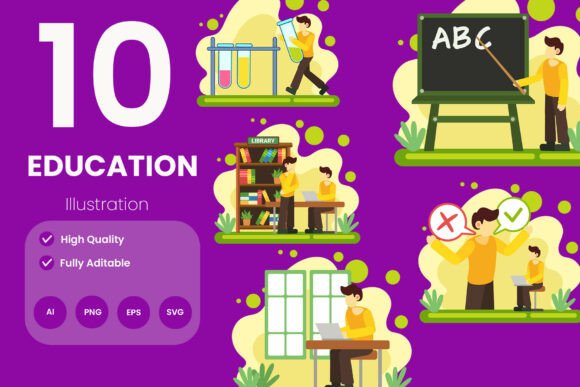
In the crowded landscape of digital learning, the visual language you choose defines your brand's credibility before a single word is read. Education concept illustrations are not merely decorative elements; they are strategic communication tools that bridge the gap between abstract academic theories and tangible user experiences. When you look at a high-quality set featuring people learning science, reading books, or engaging in school lessons, you are seeing more than just graphics. You are seeing a narrative structure designed to make complex information accessible, inviting, and human.
For web designers, educators, and content creators targeting adults aged 20 to 50, these visuals serve as the primary interface for engagement. Unlike stock photography, which can often feel staged or generic, vector illustrations offer a level of flexibility and stylistic consistency that aligns perfectly with modern UI/UX trends. They allow you to depict scenarios like gaining knowledge and skills or training at tutorials without the constraints of real-world lighting, location, or model availability.
Beyond the Classroom: Real-World Applications
The utility of education concept illustrations extends far beyond traditional K-12 websites. In the current digital economy, the definition of "education" has expanded to include professional development, corporate training, and lifelong learning platforms. Consider an online course platform launching a new module on data science. A photograph of a person staring at a computer screen might be functional, but it lacks emotional resonance. An illustration, however, can visually represent the internal process of understanding code, perhaps showing a character connecting dots or unlocking a puzzle, symbolizing the "aha!" moment of learning.
These assets are particularly effective for social media banners. In the fast-scrolling environment of Instagram, LinkedIn, or Facebook, you have mere seconds to capture attention. A banner featuring a vibrant scene of people studying at school lessons or collaborating in a workshop can stop the scroll. The flat design and bold colors typical of vector art ensure legibility even on small mobile screens, making them ideal for promoting webinars, e-books, or certification programs.
Corporate training departments also benefit significantly from this approach. When designing internal portals for employee upskilling, the tone needs to be encouraging rather than intimidating. Illustrations depicting individuals gaining knowledge and skills in a supportive environment help reduce the anxiety often associated with mandatory training. They create a safe, welcoming atmosphere that encourages participation and retention of information.
Tailoring Visuals to Specific Audiences
One of the greatest strengths of a comprehensive illustration pack is its adaptability. Different audiences respond to different visual cues. For younger adult learners returning to school, imagery that emphasizes community and collaboration—such as groups discussing topics or working together on projects—can foster a sense of belonging. For professionals seeking specific technical skills, illustrations that focus on precision, tools, and structured learning paths resonate more deeply.
Imagine a scenario where a tutoring service wants to highlight their personalized approach. Instead of a generic classroom photo, they can use a custom illustration showing a one-on-one session where a mentor guides a student through a complex diagram. This specificity tells a story that generic stock photos cannot match. It signals to the potential customer that the service understands the nuances of their specific educational journey.
Furthermore, these illustrations excel in cross-cultural communication. By avoiding specific cultural markers that might alienate certain demographics, well-designed vector art can appeal to a global audience. Whether the subject is reading a book or conducting a science experiment, the universal symbols of learning transcend language barriers, making them perfect for international e-learning platforms.
The Technical Advantage: Formats and Flexibility
From a practical standpoint, the versatility of a professional asset pack is a game-changer for web design workflows. A robust collection typically includes a variety of file formats tailored to different stages of production. Having access to EPS10 and AI files means you can edit the core vectors directly within Adobe Illustrator. This allows designers to tweak colors to match brand guidelines, change the direction a character is facing, or swap out props to fit a specific context.
For immediate deployment, the inclusion of JPG, PDF, and multiple PNG variations ensures that you have the right resolution for every need. High-resolution PNGs with transparent backgrounds are essential for overlaying text or integrating illustrations into complex layouts without unsightly white boxes. SVG files are indispensable for responsive web design, ensuring that graphics remain crisp and sharp on any device, from a large desktop monitor to a smartphone.
This multi-format approach streamlines the creative process. A designer can start with a rough mockup using low-res JPGs, refine the composition with editable AI files, and finally export optimized SVGs for the live site. The ZIP file structure containing all these assets eliminates the friction of searching for compatible versions, allowing teams to move faster from concept to launch.
Strategic Considerations Before Implementation
While the benefits are clear, successful integration requires thoughtful planning. Before selecting an illustration style, consider the overall aesthetic of your website. A highly detailed, hand-drawn style might clash with a minimalist, tech-focused interface. Conversely, a flat, geometric style might feel too sterile for a creative writing workshop. Consistency is key; mixing disparate illustration styles can confuse users and dilute your brand identity.
Another critical consideration is accessibility. While illustrations are generally easier to interpret than complex photos, they must still convey meaning clearly. Ensure that color contrasts meet WCAG standards and that the visual metaphors used are intuitive. If an illustration depicts "gaining knowledge," the symbolism should be immediately recognizable to avoid cognitive load. Additionally, always provide descriptive alt text for screen readers, explaining the context of the image for visually impaired users.
It is also important to recognize the limitations of illustration. While they excel at conveying concepts and emotions, they may not be suitable for showcasing physical products or real-world results where authenticity is paramount. For example, if you are selling a specific textbook, a photo of the actual cover is necessary. However, for the broader concept of "reading a book" or "studying," the illustration offers a more flexible and engaging alternative.
Maximizing Impact in Digital Campaigns
When executed correctly, education concept illustrations become a cornerstone of your digital strategy. They transform static web pages into dynamic storytelling environments. By leveraging scenes of people learning science, engaging in tutorials, or mastering new skills, you create an aspirational narrative that motivates users to take action.
Whether you are building a landing page for a university program, a dashboard for an LMS, or a series of social media ads for a boot camp, these assets provide the visual glue that holds your message together. They humanize the digital experience, reminding users that behind every lesson plan and curriculum is a real person eager to learn and grow. In a world saturated with information, clear, compelling, and versatile visuals are not just an option—they are a necessity for standing out and driving meaningful engagement.