10 Online Education to Kids Illustration: A Practical Guide for Designers and Educators
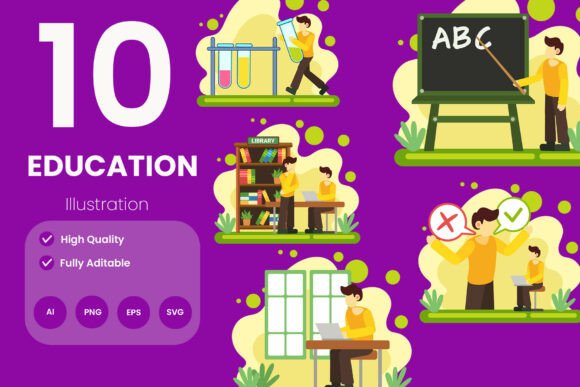
In the rapidly evolving landscape of digital learning, visual assets play a critical role in capturing attention and conveying complex ideas simply. The 10 Online Education to Kids Illustration collection represents a specific category of design resources tailored for this purpose. Unlike generic stock photography or abstract graphics, these illustrations focus specifically on knowledge books, school supplies, and learning materials rendered in a flat style cartoon background. For adults aged 20 to 50 who are responsible for curriculum development, marketing educational products, or designing user interfaces for e-learning platforms, understanding the utility and limitations of such a resource is essential for making informed procurement decisions.
Defining the Scope and Style of the Collection
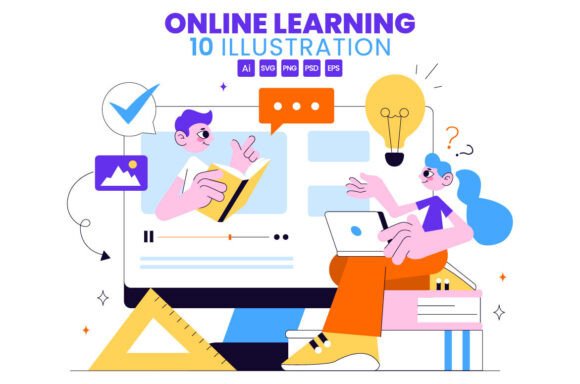
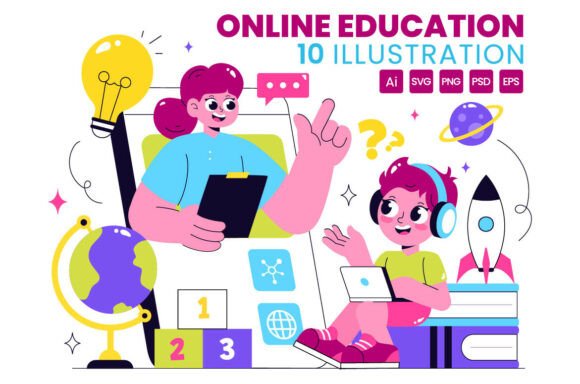
The 10 Online Education to Kids Illustration set is distinct because it consolidates a cohesive visual language into a single package. The "flat style" approach refers to a two-dimensional aesthetic that avoids gradients, shadows, and realistic textures in favor of solid colors and clean lines. This style has become a standard in modern web design and app interfaces due to its scalability and clarity on small screens.
When evaluating this specific collection, the primary subjects—knowledge books, school supplies, and learning materials—are not merely decorative. They serve as semiotic anchors that immediately signal "education" to the viewer. Whether used for a poster, a web banner, a brochure, or a landing page, these elements provide instant context. The inclusion of vector formats (AI, EPS 10, SVG) ensures that these visuals remain crisp regardless of how large they are scaled, a crucial factor for print media like brochures versus digital displays.
Technical Specifications and File Utility
A significant differentiator for this resource is the technical depth provided alongside the visuals. The package includes fully editable vector files, which allows designers to modify objects, adjust color palettes, and alter backgrounds without degrading image quality. This level of customization is often missing in raster-based alternatives like JPEGs or PNGs alone. Furthermore, the inclusion of layered PSD (Photoshop) files that are non-grouped and unlabeled offers flexibility for those working within a raster environment, though it requires a higher degree of manual organization during the editing process.
The provision of transparent PNGs adds another layer of versatility, enabling quick integration into existing layouts where a background removal would otherwise be time-consuming. For teams with mixed skill sets, having both vector and raster options ensures that everyone from the lead graphic designer to the content manager can utilize the assets effectively.
Comparing Flat Style Vectors with Alternative Visual Approaches
When selecting visual assets for online education initiatives, the 10 Online Education to Kids Illustration must be weighed against other prevalent styles. The most common alternative is photorealistic imagery. While photos offer authenticity, they can sometimes feel cluttered or dated quickly as trends change. In contrast, the flat cartoon style of this collection remains timeless and universally appealing to children and young learners.
Another comparison point is the use of hand-drawn or sketch-style illustrations. These often convey a sense of creativity and informality but may lack the structural consistency required for corporate branding or standardized testing environments. The 10 Online Education to Kids Illustration strikes a balance by offering a structured, professional look that still retains a playful tone suitable for younger audiences.
Furthermore, compared to icon-only libraries, this collection provides complete scenes and compositions. Icons are excellent for UI navigation, but they rarely suffice for hero images on landing pages or full-page posters. By offering comprehensive scenes featuring school supplies and learning materials, this resource reduces the need for composite work, saving valuable production time.
Evaluating Cost-Effectiveness and Time Investment
For organizations comparing custom illustration services against pre-made asset packs, the tradeoff is clear. Commissioning a custom illustrator to create ten unique scenes can take weeks and incur significant costs. The 10 Online Education to Kids Illustration offers an immediate solution that can be deployed almost instantly after purchase. However, this speed comes with the tradeoff of potential similarity; if multiple vendors use similar stock assets, there is a risk of visual homogenization across different educational platforms.
To mitigate this, the editable nature of the files becomes a key decision factor. If a team has the capability to tweak colors, swap out specific objects, or rearrange layers, the risk of duplication drops significantly. The ability to edit the object, color, and background means the asset can be adapted to match a brand's specific identity guidelines, bridging the gap between generic stock and bespoke design.
Best-Fit Situations and Strategic Use Cases
Determining when the 10 Online Education to Kids Illustration is the right choice depends heavily on the project's goals and constraints. This collection is particularly well-suited for:
- Landing Pages and Web Banners: The flat style loads quickly and renders sharply on all devices, ensuring high performance metrics for websites.
- Print Brochures and Posters: Because the files include high-quality vectors (AI, EPS), they are ideal for large-format printing where resolution is paramount.
- E-Learning Platforms: The consistent visual theme helps maintain user engagement and reduces cognitive load for students navigating the platform.
- Rapid Prototyping: Startups or educational institutions launching new programs can use these templates to visualize concepts before investing in final production.
Conversely, there are scenarios where this resource might not be the optimal fit. If a project requires hyper-realism to demonstrate physical products, such as a catalog for selling actual textbooks or tablets, these cartoon illustrations may lack the necessary detail. Additionally, if the target audience is strictly adult professionals rather than children or parents, the "cartoon" aesthetic might undermine the perceived authority of the content.
Limitations and Decision Factors
One limitation to consider is the scope of the "10" illustrations. While versatile, a fixed set of ten images may eventually feel repetitive if used across a massive campaign. Users should evaluate whether the variety within the pack covers their specific subject matter needs or if they will require supplementary assets later. The inclusion of a help file to view more file properties is a useful feature for verifying compatibility, but users should still test the files in their specific software versions before committing to a large-scale rollout.
Another factor is the level of design expertise required. While the files are described as easy to edit, manipulating layered PSDs or complex vector groups does require familiarity with tools like Adobe Illustrator or Photoshop. Teams without dedicated design staff might find the customization aspect challenging, potentially limiting them to using the assets in their default state.
Making an Informed Decision
Ultimately, the value of the 10 Online Education to Kids Illustration lies in its balance of accessibility, quality, and adaptability. It serves as a robust foundation for projects that need to communicate educational themes quickly and effectively. For decision-makers weighing the pros and cons, the key question is whether the need for speed and cost-efficiency outweighs the desire for entirely unique, custom-created artwork.
For most mid-sized projects, marketing campaigns, and educational product launches, this type of resource offers a pragmatic middle ground. It provides the professional polish of vector graphics and the thematic relevance of specialized subject matter without the overhead of a full custom design cycle. By leveraging the included AI, EPS, SVG, PNG, and PSD formats, teams can maximize the utility of the investment, ensuring the visuals serve multiple purposes across various media channels.
As with any creative asset, the success of the implementation depends on how well the visuals are integrated into the broader strategy. When used thoughtfully, these illustrations can enhance the user experience, clarify complex information, and create a welcoming atmosphere for learners of all ages. For those ready to proceed, reviewing the preview JPEGs and help files first will ensure the assets align perfectly with the project's specific requirements before any further steps are taken.